
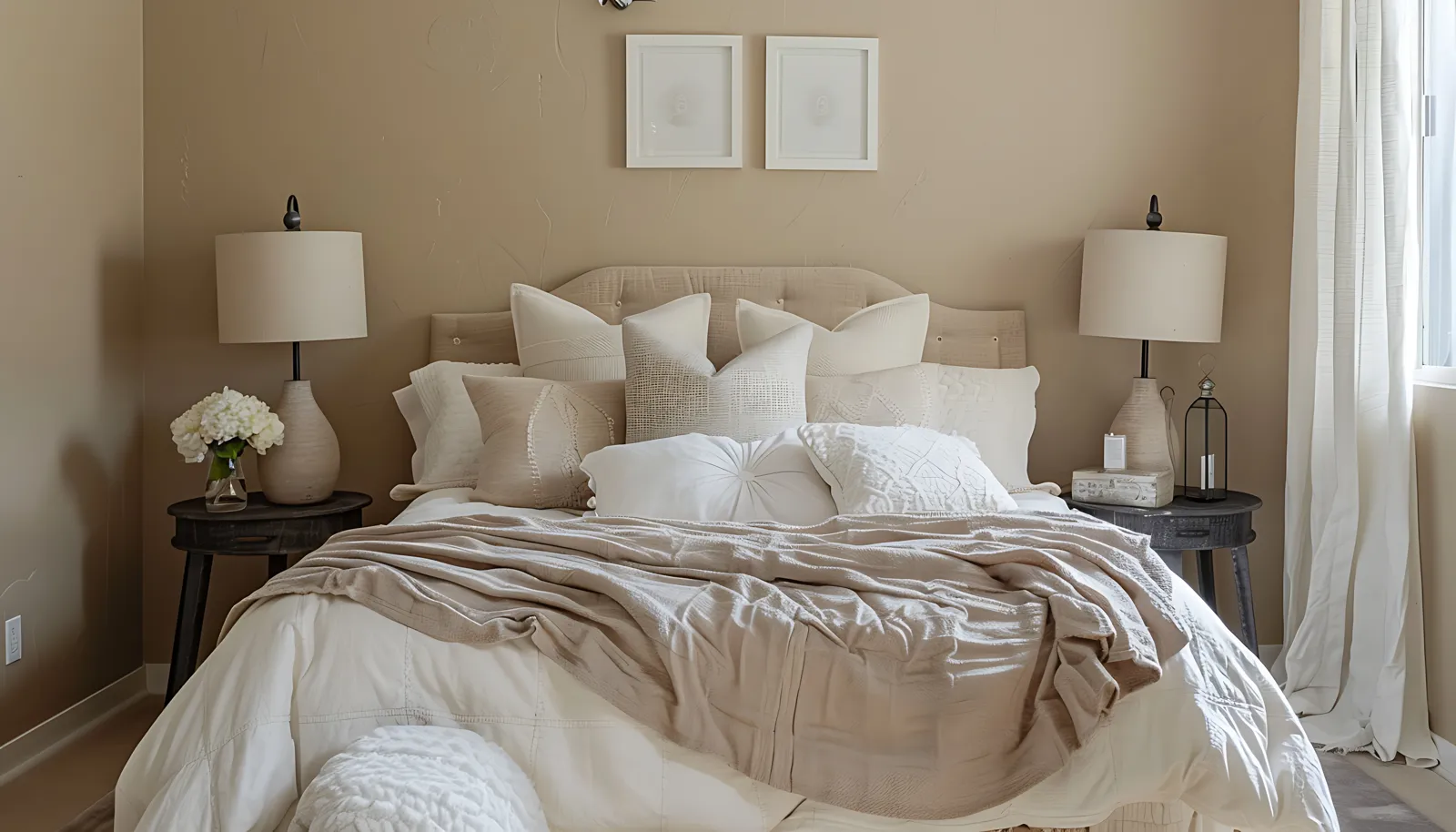
Bedroom Layout by Bed Size with Rug and Nightstand Rules
An 8x10 rug leaves 30 inches on each side of a queen but only 22 on a king, and a king with two nightstands needs about 11 feet of wall. Room size, rug, nightstand and art measurements for every US bed size, in one chart.

In this article
- 1Bedroom layout by bed size
- 2How much wall you need behind the bed
- 3What size rug for a queen, king or full bed
- 4How much space around a bed
- 5Where to put the bed
- 6Nightstand height and size
- 7Art above the bed and bedside lamps
- 8Bedding, curtains and color
- 92026 primary bedroom trends worth keeping
- 10Bedroom layout mistakes I fix most
- 11Getting help in Flower Mound and DFW
An 8x10 rug leaves 30 inches on each side of a queen bed and only 22 on a king, which is why so many primary bedrooms look a little off even with a brand-new rug. A good bedroom layout starts with the bed size: it sets the room you need, the headboard wall, the rug, the nightstands and the art above the bed. Before I move anything in a Flower Mound or Dallas–Fort Worth bedroom, I measure three things: the headboard wall, the mattress height with the bedding on, and the rug width.
How do you lay out a bedroom? Start with the bed. Pick a size that leaves 30 inches of walkway on the sides you use, center it on the longest solid wall, add a rug that extends at least 18 inches past each side, keep nightstands within 2 inches of mattress height and hang art about two-thirds the bed's width.
Bedroom layout by bed size
US mattress sizes are standardized, so the same numbers work in every store. This is the chart I use to decide which bed fits a room and which rug it calls for. The last column is plain arithmetic you can repeat with any rug: the rug's long side minus the mattress width, divided by two.
| Bed | Mattress | Minimum room | Comfortable room | Rug | Rug past each side |
|---|---|---|---|---|---|
| Twin | 38 x 75 in | 70 sq ft | 80 to 100 sq ft | 5x7 or 6x9 | 23 in with 5x7, 35 in with 6x9 |
| Full | 54 x 75 in | 100 sq ft | 110 to 120 sq ft | 6x9 or 8x10 | 27 in with 6x9, 33 in with 8x10 |
| Queen | 60 x 80 in | 10 x 10 ft | 12 x 12 ft | 8x10 | 30 in |
| King | 76 x 80 in | 12 x 12 ft | 12 x 14 ft | 9x12 | 34 in with 9x12, 22 in with 8x10 |
| California king | 72 x 84 in | Same as king | Same as king | 9x12 or 10x14 | 36 in with 9x12, 48 in with 10x14 |
The frame adds inches, so measure the bed frame or base, not just the mattress, and take 1 to 3 inches off the rug numbers if the frame is wider. Winged or upholstered headboards can add more.
How much wall you need behind the bed
The headboard wall is where most king plans fail. My math is the mattress width plus two 24-inch nightstands and a 4-inch gap on each side. With 20-inch nightstands, subtract 8 inches.
If your wall is 10 feet, a king still fits, but only with narrow nightstands or a single one. A California king is 4 inches narrower and 4 inches longer than a king, which makes it the better choice for a narrow wall in a long room.
What size rug for a queen, king or full bed
Lay the rug perpendicular to the bed, with the long side running across it. The goal is to step onto rug when you get up, which takes at least 18 inches on each side.
That is why a king calls for a 9x12: with an 8x10 it gets 8 inches less per side than a queen. There are three ways to place the rug. An 8x10 under a queen starts just in front of the nightstands and covers the lower two-thirds of the bed. A 9x12 holds everything, bed and nightstands. Either way, keep nightstands fully on the rug or fully off it. If the room is too small for a large rug, two runners along the sides of the bed beat one small rug in the middle.
How much space around a bed
Leave at least 24 inches on each side you use to get in and out, and aim for 30 to 36 inches. Keep 36 inches in front of a dresser so the drawers open, and go to 30 inches or more on a storage bed or where two people pass. Here is how a queen works in a 12x12 room:
Do not forget the door and the closet. A swinging door needs a clear arc as wide as the door itself, and a closet with hinged doors needs the same clearance as a dresser. If the bed base comes in one piece, measure the doorway and the stairs before buying, the same check I recommend for sofas in how to decorate a small living room.
Where to put the bed
The bed usually goes on the longest solid wall, centered, so the walkways on both sides match. You should see the bed from the door, ideally without lining up directly with it.
A bed in front of a window works if the headboard stays low and the window still opens. In most US homes the bedroom window is the emergency exit, and building code keeps its sill no higher than 44 inches off the floor, so a tall headboard or a bed pushed against it should never block it. A bed in a corner, with one side on the wall, only makes sense for one sleeper.
Nightstand height and size
The top of the nightstand should sit level with the mattress, or within 2 inches above or below it. Most nightstands are 24 to 28 inches tall and 20 to 30 inches wide, and they should sit about 4 inches from the frame so bedding clears them.
Measure the mattress with the bedding on. A pillow top or a thick protector can add several inches, and that is when a nightstand that looked right suddenly sits low. The two nightstands do not have to match, but their heights should be close.
Art above the bed and bedside lamps
As a rule of thumb, hang the bottom of the frame 6 to 10 inches above the headboard and size the art to about two-thirds of the bed's width, roughly 40 inches over a queen and 51 inches over a king. With no headboard, hang it lower, about 10 to 12 inches above the mattress. The 57-to-60-inch center rule I use in living rooms does not apply here; in a bedroom the headboard is the reference. That living room rule is in how to refresh your living room without buying anything.
For lamps, the bottom of the shade should land around eye level when you sit up in bed, so you never see the bulb from the pillow. Add an overhead light and one accent light, like a floor lamp in a reading corner, and you have three layers. I use 2700K bulbs and matte or eggshell walls in bedrooms; the full bulb and finish chart is in how to choose paint colors for your home remodel.
Bedding, curtains and color
Layer the bed from the bottom up: sheet, duvet or coverlet, a throw folded at the foot, then pillows. Two sleeping pillows per person are enough; the 2026 look is a leaner bed with fewer throw pillows and one long lumbar across the width. When the bedding is plain, texture does the work: linen, washed cotton and a quilted coverlet look more finished than a pile of patterned pillows.
West-facing windows in North Texas take hard afternoon sun, so in bedrooms I use full-height blackout curtains that also cover the window edges. A linen panel over a blackout liner gives you both softness and a dark room. For color, light muted tones open a small room, and a dark wall behind the headboard makes a big primary bedroom feel cozier.
2026 primary bedroom trends worth keeping
The ideas I see lasting are the ones that do not depend on a matching set: a light oak nightstand next to an upholstered bed instead of a full suite, canopy beds, bedding with color and pattern, earthy tones like terracotta and clay, and a small reading corner with a chair in the primary bedroom.
Bedroom layout mistakes I fix most
- A 5x8 rug under a king, which reads as a bath mat.
- Nightstands lower than the mattress, usually after upgrading to a taller mattress.
- A king on a wall under 11 feet with full-size nightstands squeezed in.
- Art wider than the bed or floating too high above the headboard.
- Bulbs visible from the pillow because the shades are too short.
- A tall headboard blocking the egress window.
Getting help in Flower Mound and DFW
Many bedrooms come together without buying anything: turning the rug 90 degrees, moving the bed to another wall or lowering the art. If you would rather do it together, an express decor session or in-home consultation is where I measure your bedroom and rearrange it with your own furniture in Flower Mound and across Dallas–Fort Worth. If you are working through the whole house, start at the front door with how to decorate an entryway.
Frequently asked questions
How much space do you need around a bed?
Leave at least 24 inches on each side you use to get in and out, and aim for 30 to 36 inches. Keep 36 inches in front of a dresser so the drawers open fully, and 30 inches or more if the bed has storage drawers. A solo sleeper can push one side against a wall.
What size rug goes under a queen bed?
An 8x10-foot rug is the standard pick for a 60x80-inch queen. Laid with the 10-foot side across the bed, it extends about 30 inches past each side. A 6x9 leaves 24 inches but stops short of the nightstands, and anything smaller than 5x8 looks lost under a queen.
Is an 8x10 rug big enough for a king bed?
It works in a tight room, but it only extends about 22 inches past each side of a 76-inch king. A 9x12 rug gives about 34 inches per side and can hold the bed and both nightstands. For a California king, 9x12 or 10x14 are the usual sizes to shop for.
How tall should a nightstand be?
The top of the nightstand should sit level with the top of the mattress, or within 2 inches above or below it. Most nightstands are 24 to 28 inches tall and 20 to 30 inches wide. Leave about 4 inches between the nightstand and the bed frame so bedding clears it.
What size room do you need for a king bed?
Plan on at least a 12x12-foot room for a 76x80-inch king, and 12x14 feet for real comfort. The headboard wall needs about 11 feet to fit the bed plus two 24-inch nightstands with a 4-inch gap on each side. In a 10x10 room, a queen is the better fit.
How high should you hang art above a bed?
As a rule of thumb, hang the bottom of the frame 6 to 10 inches above the headboard, a little higher if the headboard is tall and upholstered. Size the art to about two-thirds of the bed's width, which is roughly 40 inches over a queen and 51 inches over a king.
Can you put a bed in front of a window?
Yes, if the headboard stays low and the window still opens. In most US homes the bedroom window is the emergency exit, with a sill no higher than 44 inches off the floor, so a tall headboard should never block it. Full-height blackout curtains help with Texas afternoon sun.
Keep reading

Interior decorator in Flower Mound, Texas. I help families across the Dallas–Fort Worth area create homes that feel beautiful, organized and calm.